
Safest First: Ordering a Migration by Blast Radius, Not by Image Count
The nine-registry routing queue is sorted safest-first: gcrmirror touches one scanner, quay touches OpenBao's StatefulSet, and dragonflydb — GitLab's own Redis — comes with a note that skipping it is a reasonable choice.
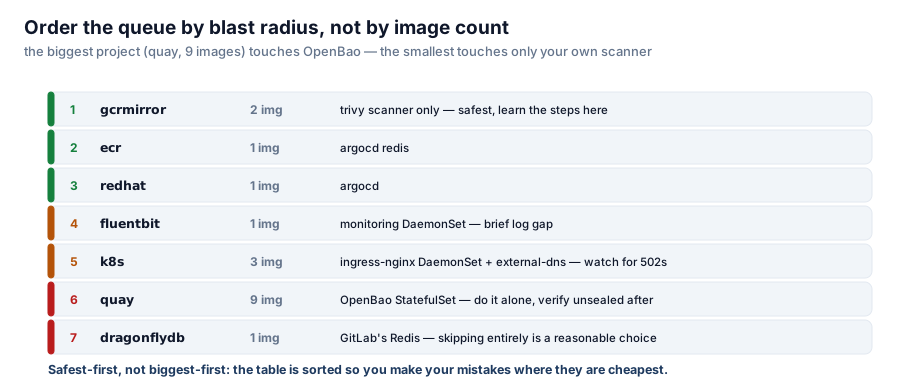
Every migration table has two possible sorts: by value, or by danger. The registry-routing runbook carries both, and keeps them in different columns — value decided that gitlabcom goes first; blast radius decides the order you learn the procedure in.
The blast-radius column
| Order | Registry | Images | Restart blast radius |
| 1 | gcrmirror | 2 | trivy only — safest, do this first |
| 2 | ecr | 1 | argocd redis |
| 3 | redhat | 1 | argocd |
| 4 | fluentbit | 1 | monitoring DaemonSet — brief log gap |
| 5 | k8s | 3 | ingress-nginx DaemonSet, external-dns — watch for 502s |
| 6 | quay | 9 | OpenBao StatefulSet — do alone, verify unsealed after |
| 7 | dragonflydb | 1 | GitLab StatefulSet — its Redis. Consider skipping |
The biggest project is near the bottom of the learning order. quay has the most images and touches the one StatefulSet in the cluster whose restart requires unsealing — do it once the steps are muscle memory, and do it alone.

The runbook's ordering, with the reasoning inline — including the one entry where skipping is explicitly endorsed.
StatefulSets and DaemonSets go last, with different verbs
Two operational details the table encodes. Rolling a DaemonSet restarts ingress or log shipping on each node in turn — expect a short gap, and watch for 502s on the ingress one. And the restart verbs differ:
kubectl -n <ns> rollout restart statefulset/<name>
kubectl -n <ns> rollout restart daemonset/<name>
The runbook also warns that names are not what you expect: on the first pass, three of five guessed GitLab workload names did not exist. List them first with kubectl get deploy,statefulset,daemonset -o custom-columns=..., then restart what is actually there.
How the blast-radius column is built
The column is not intuition; it is derived from the estate. For each registry, the routing team listed the workloads whose images come from it (from the digest-joined pod data), then annotated each with the kind of restart it means:
- a Deployment with replicas — rolling restart, no gap;
- a DaemonSet — restarts node-by-node; for ingress-nginx that is brief 502s per node, for fluent-bit a short per-node log gap;
- a StatefulSet — an ordered restart with state attached; for OpenBao specifically, a post-restart unseal verification.
That taxonomy, not the image count, is what the order encodes. quay outranks ghcr in image count (9 vs 11 is close) but loses on restart class: OpenBao is the only workload in the cluster whose restart requires a credential ceremony to recover from.
The workload-name trap
On the first pass, three of five guessed GitLab workload names did not exist — the actual names differ from the chart's release names in ways that are obvious in hindsight (gitlab-gitlab-shell, not gitlab-shell; backups as Jobs, not Deployments). The runbook's fix is to list before restarting:
kubectl -n <ns> get deploy,statefulset,daemonset \
  -o custom-columns='KIND:.kind,NAME:.metadata.name,READY:.status.readyReplicas' --no-headers
Restart what is listed, not what is remembered. The same trap has a quieter variant: finished Jobs never restart, so the estate image count always includes a few direct references that no routing pass will ever move — the runbook's progress command carries the caveat, and three GitLab backup Jobs account for the residual count.
The explicit skip
dragonflydb — one image, GitLab's Redis — carries the runbook's only endorsed skip: consider skipping this registry entirely. The reasoning is proportionality: the procedure's full ceremony (endpoint, project, pull test, rule MR, canary, full restart of a StatefulSet) buys one image that already scans at runtime. Writing the skip down is as much a part of the runbook as the steps — it tells the next operator that "not done" can be a decision rather than an omission, and it prevents the completeness instinct from spending an afternoon on the estate's least valuable registry.
Next: the honest ceiling — why 38 of 94 images can never route through Harbor at all.