
Trivy Operator Does Not See Drift
Install a package into a running container and poll its VulnerabilityReport for four minutes. resourceVersion, updateTimestamp, and every severity count stay frozen — the report describes the image at scan time, not the container that's actually running.
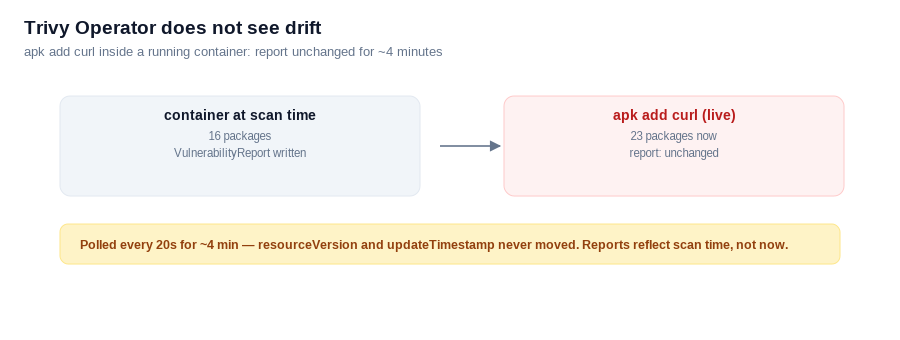
The test (A009) was simple enough to run in one terminal: exec into a running poc-alpine container, run apk add curl, then poll that container's VulnerabilityReport every 20 seconds for four minutes and watch for any sign that Trivy Operator noticed.
What actually changed, and what didn't
The image's own SBOM report recorded 16 components before the change. Measuring installed packages inside the running container after apk add curl — apk info | wc -l — came back at 23. Seven new packages, curl and its dependencies, now present in a container Trivy Operator had already scanned and reported on.
The VulnerabilityReport for that workload was polled twelve times, at 20-second intervals, from t=+20s to t=+240s. Every single poll returned the identical resourceVersion, the identical updateTimestamp, and the identical severity summary:
t=+20s  resourceVersion=6368675978 updateTimestamp=2026-08-10T11:38:49Z
        summary={"criticalCount":0,"highCount":0,"lowCount":0,"mediumCount":0,"noneCount":0,"unknownCount":0}
...
t=+240s resourceVersion=6368675978 updateTimestamp=2026-08-10T11:38:49Z
        summary={"criticalCount":0,"highCount":0,"lowCount":0,"mediumCount":0,"noneCount":0,"unknownCount":0}
Same resourceVersion at t=+240s as the value recorded before the exec. Not one field moved, across four minutes and twelve checks, while the running container's package count grew by nearly half.

16 packages at scan time, 23 in the running container four minutes later. The report never moves.
Why the report doesn't move
The VulnerabilityReport a workload carries is the output of a scan against an image reference — a digest, evaluated once. It is not a live process that watches the container's filesystem. apk add curl inside a running container changes that container's actual state without changing the image it was created from, and nothing in Trivy Operator's reconciliation loop is watching the container's writable layer for exactly that reason: there's no trigger to re-scan a workload whose image reference hasn't changed, because from the operator's point of view nothing did.
What this means for anyone reading the dashboard
A VulnerabilityReport with zero Critical, zero High, and every other count at zero is a true statement about the image at the moment it was scanned. It is not a claim about the container that's running right now, and this test shows the gap isn't theoretical — a single apk add from inside the container is enough to break the correspondence, and Trivy Operator has no mechanism that would ever notice. Anyone treating a clean VulnerabilityReport as an attestation of current runtime state is trusting a number that stopped updating the moment the scan finished.
Next: your vulnerability history is a ReplicaSet side effect — the same reports, and what deleting a Deployment does to the history behind them.