
Debugging a Cryptic Third-Party Embed Error
Every recorded qasida's YouTube embed failed with error 153. Two rounds of fixes at the player level didn't touch it, because the actual cause was a Django security default silently starving the Referer header.
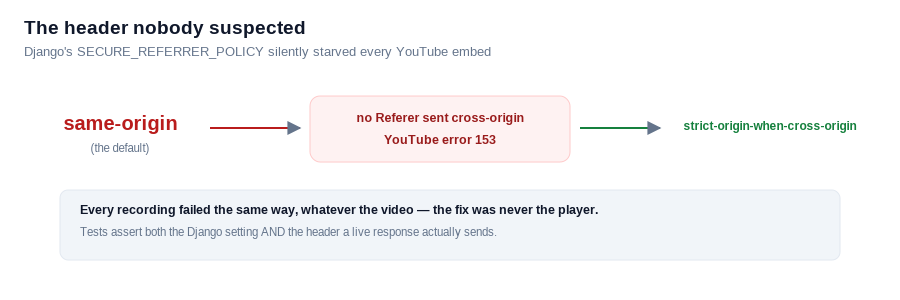
Error 153 from a YouTube iframe tells you almost nothing. It usually means the video owner disabled embedding — except here it didn't, because every recording failed identically, regardless of which video or which owner's settings. That uniformity was the clue, and it took two rounds of plausible but wrong fixes before the actual cause surfaced.

Django's default Referrer-Policy sends nothing cross-origin. YouTube reads that header to verify the embedding page — with nothing to read, it declines.
Round one: plausible, and partially right
The first fix addressed two real but insufficient issues: embeds were using youtube-nocookie.com, which YouTube documents as refusing more videos than the main host, and the iframe had no explicit origin parameter, which YouTube uses to verify which site is embedding it:
@property
def embed_url(self):
    # The nocookie host refuses more videos than the main one, which shows
    # up as an in-player error rather than anything we can catch, so the
    # main embed host is used.
    return f"https://www.youtube.com/embed/{self.video_id}" if self.video_id else ''
Plus a fallback link out to YouTube directly, for the case a change like this genuinely cannot fix — an owner who disabled embedding altogether. Reasonable engineering. Didn't fix error 153, because 153 wasn't about the video host or the origin parameter at all.
Round two: the actual cause
Django's SecurityMiddleware defaults SECURE_REFERRER_POLICY to same-origin — a sensible privacy default in isolation, and precisely the setting that silently starves a cross-origin embed of the one header it needs. same-origin sends no Referer header at all on a cross-origin request. YouTube reads that header specifically to determine which site an embed is being played from; given nothing to read, it declines and reports error 153. The commit's framing is worth quoting directly:
The videos were never the problem... Earlier work on the player added click-to-load and a link out to YouTube for owners who disallow embedding. That was the symptom, not this — and it is why the error survived the fix.
The fix is a one-setting change, to strict-origin-when-cross-origin — the modern browser default, which sends the requesting origin (not the full URL, so which specific qasida page a reader is on stays private) and sends nothing at all if the connection downgrades to plain HTTP:
SECURE_REFERRER_POLICY = 'strict-origin-when-cross-origin'restated on the iframe itself (frame.referrerPolicy = 'strict-origin-when-cross-origin') so the embed keeps working even if the site-wide header setting is tightened again later without anyone connecting that change back to video playback.
Testing a header, not just a behavior
The regression risk here is specific enough to be worth naming: this is exactly the kind of setting that gets hardened again in good faith by someone doing an unrelated security pass, with a cost that's completely silent — every video breaks, and nothing in the application logs so much as a warning. The tests assert both ends of the chain, not just one:
def test_something_reaches_youtube(self):
    from django.conf import settings
    self.assertNotIn(settings.SECURE_REFERRER_POLICY,
                     self.SILENT_ACROSS_ORIGINS, ...)

def test_the_header_is_actually_sent(self):
    response = self.client.get(reverse('browse'))
    self.assertNotIn(response.headers.get('Referrer-Policy'),
                     self.SILENT_ACROSS_ORIGINS)
The general lesson: when a third-party integration fails uniformly across every instance of it, stop looking at the integration code and start looking at what's shared underneath it — a header, a default, a piece of middleware — because uniform failure is a strong signal the fault isn't where the symptom shows up.
Series: Qasida App.