
The Allowlist That Changes Nothing You Can See
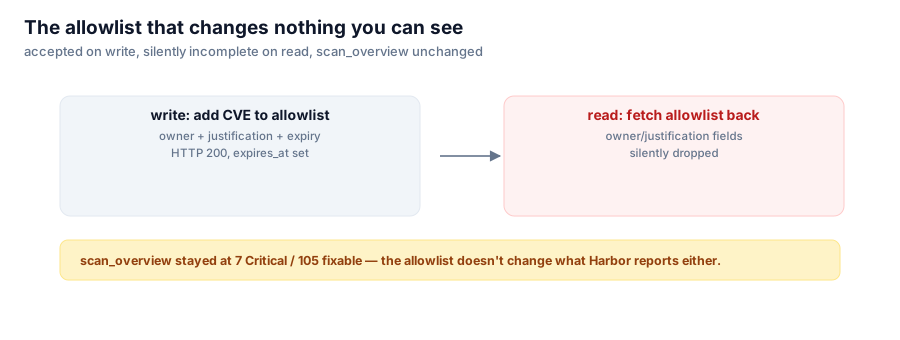
Add a CVE to Harbor's system allowlist with an owner and a justification. Harbor returns 200, silently drops both fields, and leaves every number in scan_overview identical. The only place the allowlist shows up is the gate's arithmetic.
A CVE allowlist is an exception register, and an exception register that does not record who granted the exception and why is not an audit artifact. So the first thing we tried on Harbor's system allowlist was to write those fields.
The baseline for tc01, before touching anything:
{"fixable":105,"summary":{"Critical":7,"High":41,"Low":100,
 "Medium":111,"Unknown":10},"total":269}
Then the system allowlist was set to two gnutls CVEs with an expiry of 2026-12-31. Harbor returned 200 and stored exactly this:
{"expires_at":1798660800,"id":3,
 "items":[{"cve_id":"CVE-2026-33845"},{"cve_id":"CVE-2026-42010"}],
 "creation_time":"2026-08-10T12:00:10.058Z",
 "update_time":"2026-08-10T12:00:10.058Z"}
Owner and justification: accepted, then gone
The next call added owner and justification fields to the same items. Harbor answered HTTP 200 — no schema error, no warning, no unknown-field rejection. The readback:
{"creation_time":"2026-08-10T12:00:12.869Z","expires_at":1798660800,"id":3,
 "items":[{"cve_id":"CVE-2026-33845"},{"cve_id":"CVE-2026-42010"}],
 "update_time":"2026-08-10T12:00:12.869Z"}
The update_time moved — the write really happened — and the extra fields are simply not there. An item in this list is a cve_id and nothing else. The whole record consists of an id, an expiry, two timestamps, and a set of CVE identifiers. Your reason for granting the exception lives wherever you chose to keep it, which is to say: not in Harbor.
The numbers do not move either
With the allowlist active, the same scan_overview query returns:
{"fixable":105,"summary":{"Critical":7,"High":41,"Low":100,
 "Medium":111,"Unknown":10},"total":269}
Byte-for-byte the baseline. Both allowlisted CVEs are still present in the detailed report, still marked Critical, still status: fixed. Allowlisting is not suppression: the UI counters, the severity breakdown, and the report rows are all unchanged.

Three readbacks after the write — schema, summary, detailed report — and the only number that ever reacts is the one inside the policy error.
Where the allowlist actually shows up
It shows up in one place: the gate's arithmetic, visible only in the text of a 412. The project fixture had CVE-2023-45853 in its own project-level list with reuse_sys_cve_allowlist: false. The scan reports 269 findings; the policy violation message says 268. One allowlisted CVE, one subtracted finding, and that subtraction is the only externally visible effect of the entire mechanism.
Two further probes confirm it is a real gate input rather than decoration. Allowlist all 7 Critical CVEs with an expiry in the future, and the manifest GET returns HTTP 200 — pull allowed. Keep the identical list and move expires_at into the past, and the same GET returns HTTP 412, back to "current image with 269 vulnerabilities cannot be pulled…" — the full 269 again, because an expired list allowlists nothing.
What this means operationally
Treat the Harbor allowlist as a gate parameter, not as a register of decisions. The register — who approved this exception, against which ticket, for what compensating control — has to live in Git next to the rest of your policy, because the API will take those words from you with a 200 and discard them. And when someone asks why the dashboard still shows 7 Critical on an image they were told is exempt, the honest answer is that the allowlist was never going to change that number.
The expiry, at least, is real and enforced. That is the one part of this mechanism you can rely on to fail closed.
Next: Harbor's scan-all schedule only accepts a custom cron — the preset Daily and Weekly options the API rejects outright.